2026: What Small Businesses Need to Focus on Next
We are a quarter of the way in to 2026 and things are changing and, as small business owners, we are facing challenges we didn’t foresee. It’s no longer just about reacting to change—it’s about preparing for it with intention.
After years of economic uncertainty, digital acceleration, and shifting customer behaviour, the next phase is becoming clearer. The businesses that succeed won’t necessarily be the biggest or fastest growing. They’ll be the ones that understand the landscape early and position themselves accordingly.
This is where future-focused planning becomes essential.
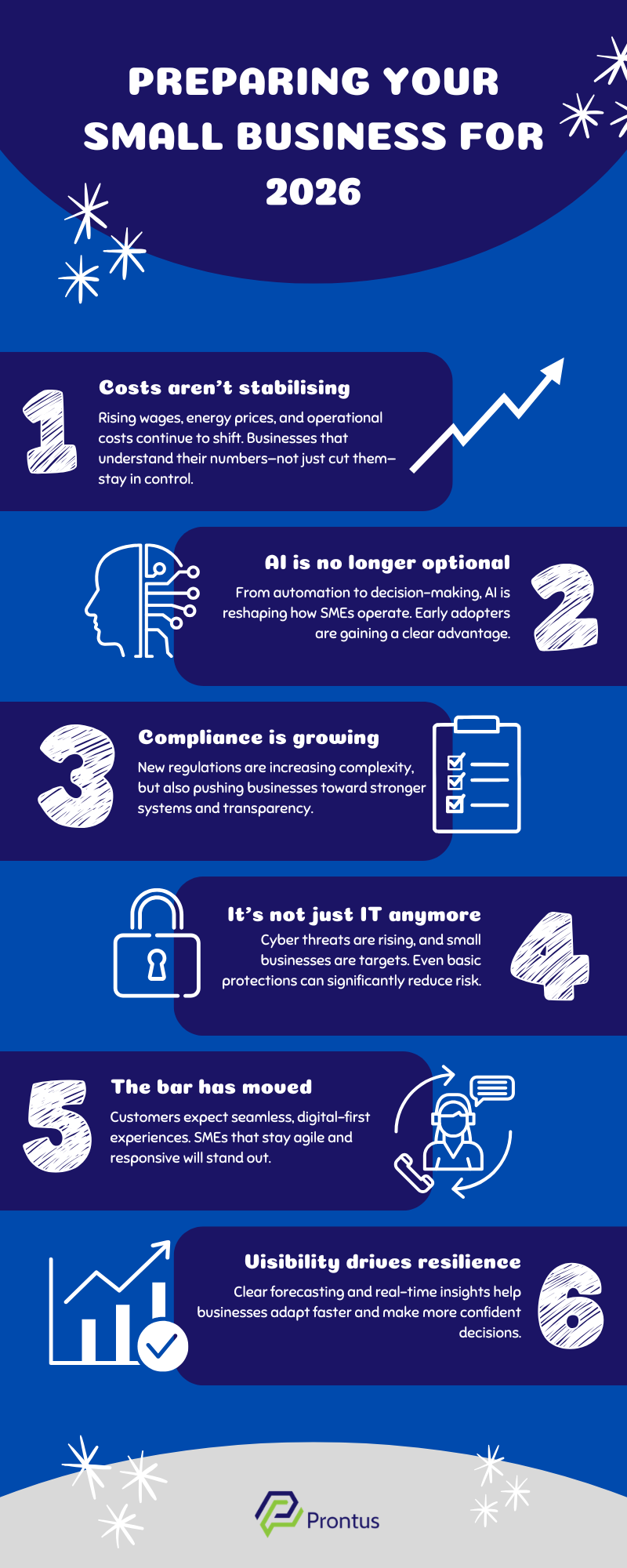
Costs Are Changing—Not Settling
For many SMEs, rising costs have been the dominant challenge over the past few years. But heading into 2026, the issue isn’t just that costs are high—it’s that they are becoming less predictable and more complex.
Energy prices, wages, supply chain pressures, and regulatory costs continue to evolve. This makes traditional cost-cutting approaches less effective on their own. Instead, businesses need a deeper understanding of where pressure is coming from and how it impacts margins over time.
Clarity becomes more valuable than control. Businesses that invest in understanding their cost structures—and build flexibility into their operations—will be far better positioned to adapt.
AI Adoption Is Becoming a Competitive Divider
Artificial intelligence is no longer a future trend—it is already reshaping how small businesses operate. From automating routine tasks to improving decision-making, AI is quietly becoming embedded in day-to-day operations.
What’s emerging is a growing gap between businesses that are actively adopting these tools and those that are not. This isn’t just about efficiency; it’s about capability. Businesses using AI are able to move faster, test ideas more quickly, and operate with leaner resources.
For many SMEs, the opportunity lies in starting small but thinking strategically. Integrating AI into existing workflows—rather than overhauling everything at once—can unlock meaningful gains without adding complexity.
Regulation Is Increasing—and Expectations Alongside It
The regulatory environment for UK businesses continues to evolve, with new requirements around reporting, employment, and data management becoming more prominent.
While this can feel like an additional burden, it also reflects a broader shift toward accountability and transparency. Businesses are increasingly expected to operate with clearer processes, stronger governance, and more structured systems.
Those that approach regulation reactively may struggle to keep up. Those that build it into their operational foundations will find it easier to scale and maintain trust with customers and partners.
Cybersecurity Is Now a Core Business Concern
Cybersecurity is often still viewed as a technical issue, but in reality, it is a business-critical risk. As digital reliance increases, so does exposure to potential threats.
For small businesses, this can be particularly challenging. Limited resources often mean security is addressed only when something goes wrong. However, the cost of inaction can be significant—not just financially, but reputationally.
Preparing for 2026 means treating cybersecurity as part of overall business resilience. Even simple measures, such as improving internal awareness and strengthening basic protections, can reduce risk substantially.
No business is out of reach of cyber criminals. The Cyber Essentials certification is one step in the right direction!
Customer Expectations Continue to Shift
Customer behaviour is evolving at a rapid pace, influenced by digital experiences, convenience, and growing awareness around sustainability and values.
What was once considered a competitive advantage—fast service, seamless digital interaction, clear communication—is now expected as standard. This raises the bar for small businesses, but it also plays to their strengths.
Unlike larger organisations, SMEs have the ability to adapt quickly, personalise experiences, and stay close to their audience. The challenge is maintaining that agility while continuing to evolve.
Financial Visibility Will Define Resilience
One of the most important factors heading into 2026 is financial clarity. Many businesses still operate without real-time visibility or forward-looking forecasting, which makes it difficult to respond proactively to change.
As uncertainty continues, this becomes a critical weakness. Businesses that understand their numbers—cash flow, margins, and potential scenarios—are far better equipped to make confident decisions.
This isn’t about perfection. It’s about having enough insight to act early rather than react late.
Final Thoughts: Preparation Over Prediction
It is impossible to predict exactly what 2026 will bring. But uncertainty does not have to mean instability.
The businesses that thrive will be those that focus on preparation rather than prediction. That means building flexibility, investing in the right tools, and maintaining a clear understanding of both risks and opportunities.
Success in 2026 is unlikely to come from doing more. It will come from doing the right things—with greater clarity, consistency, and intent.
We’re already in 2026—and the pace of change isn’t slowing down.
The challenge for small businesses now isn’t predicting what’s next, but staying ready for what’s already happening.
Disclaimer
This content is intended for general informational purposes only and does not constitute professional, financial, or legal advice. Every business is different, and decisions should be made based on your specific circumstances. If you are unsure, seek advice from a qualified professional.