Payroll Challenges Growing Businesses Face (and How to Solve Them)
Payroll is one of the most mission‑critical functions in any business — but as companies scale, it can quickly shift from a well‑managed task to a recurring headache. Payroll issues don’t just slow down your finance team; they impact cash flow, compliance, employee trust, and ultimately your ability to grow.
Below are some of the most common payroll challenges growing businesses face, along with practical solutions to help you stay ahead of the pain points.
1. Manual Payroll Processes That Don’t Scale
When your business was small, manual payroll — spreadsheets, calculators, and manual overrides — might have felt manageable. But as staff levels increase, so do errors, bottlenecks, and time spent on routine tasks. Manual payroll processes lead to:
Calculation mistakes
Misfiled deductions
Late submissions
Low visibility across pay cycles
These issues cost time and frustrate your finance team.
Solution:
Invest in reliable payroll software that automates tax calculations, net‑to‑gross pay, payslip generation, and statutory filings. Modern platforms eliminate repetitive tasks, reduce human error, and free your team to focus on strategic priorities.
2. Keeping Up With Compliance and Regulatory Change
UK payroll is governed by constantly evolving legislation — from National Insurance adjustments to minimum wage increases and reporting requirements like Real Time Information (RTI). Missing a deadline or misapplying a rule can lead to fines, HMRC penalties, and unhappy employees.
Solution:
Build a compliance framework that includes:
Payroll software with automatic updates for tax bands and legislation
Regular training for payroll or HR staff
Alerts and checklists for key filing deadlines
Staying up to date reduces the risk of penalties and builds confidence in your internal processes.
3. Complex Pay Structures and Diverse Workforces
As your business grows, so does payroll complexity. Overtime, commission structures, bonuses, and variable pay make calculations harder — especially when you also employ full‑time, part‑time, contractor, and remote workers.
Solution:
Use payroll systems that can handle multiple pay types and integrate with time and attendance tools. This ensures accurate hours calculation and avoids misclassification errors that lead to compliance issues.
4. Lack of Payroll Visibility and Reporting
Without clear reporting tools, business leaders struggle to forecast labour costs accurately or understand trends like overtime spikes, holiday liabilities, or payroll tax burdens. Limited visibility makes budgeting and strategic planning harder.
Solution:
Choose payroll software with robust reporting dashboards that give you real‑time insights into wage costs, payroll liabilities, tax obligations, and workforce metrics — so you can plan ahead, not react.
5. Employee Access and Communication Issues
Payroll isn’t just a back‑office function — it affects every team member. If employees can’t easily view their payslips, tax codes, or deductions, your HR team ends up fielding repeated questions, which drains time and creates frustration.
Solution:
Implement an employee self‑service portal where staff can access their payroll information securely. This improves transparency, builds trust, and drastically reduces administrative queries.
6. Security and Data Protection Risks
Payroll systems contain sensitive data — from bank details to national insurance numbers. Storing this information in unsecured spreadsheets or outdated systems hugely increases the risk of data breaches and compliance violations.
Solution:
Ensure your payroll software meets modern security and encryption standards. Limit access to authorised individuals, and regularly update permissions and password policies to protect employee information.
7. Lack of Scalability in Tools and Processes
Many businesses start with an inexpensive or basic payroll solution — and discover too late that it can’t handle growth. What worked for 10 employees won’t necessarily handle 50 or 100, especially if you expand into new locations or offer more pay variation.
Solution:
Review your payroll tools annually to evaluate scalability. If your software can’t support automation, flexible pay structures, or increased reporting demand, it’s time to upgrade to a solution designed for growth.
How Outsourcing Payroll Can Help
Outsourcing payroll to a specialist provider can be a game‑changer for growing businesses. Experts who live and breathe payroll can:
Ensure compliance with the latest UK tax laws
Handle payroll complexity without stress
Offer support through pay rises, bonuses, and benefits changes
Provide a single point of contact for queries and issues
This frees your internal team to focus on growth, not spreadsheets.
How Prontus Makes Payroll Simple for Growing Businesses
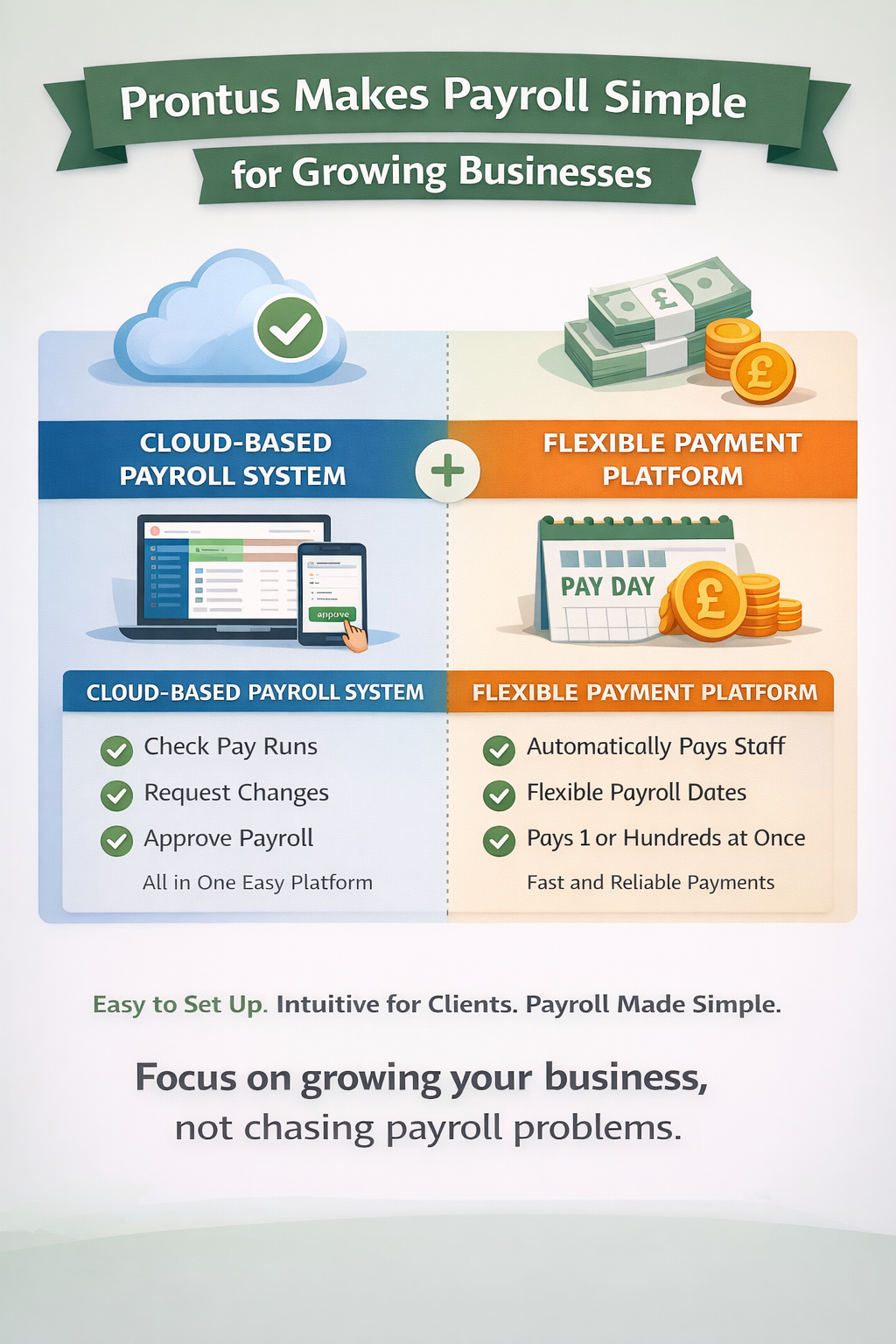
At Prontus, we understand that payroll challenges can slow growth and create unnecessary stress. That’s why we use a cloud-based payroll system designed to make life easier for both our clients and their employees.
With our system, clients can:
Check over payroll anytime before submission
Send messages or requests for changes directly within the platform
Approve payroll once everything is correct — one click, and it’s done
No more endless back-and-forth emails, confusing spreadsheets, or last-minute corrections.
We also integrate a flexible payment platform that allows us to:
Queue salaries and wages in advance
Pay employees automatically just after midnight on their chosen pay day
Handle payments for one person or hundreds at once
Both tools are easy to set up, intuitive to use, and take the stress out of payroll. By combining automation, real-time visibility, and simple approval processes, Prontus helps growing businesses focus on scaling, not chasing spreadsheets.
Final Thoughts
Payroll challenges are normal — but they shouldn’t slow your growth. With the right technology, processes, and expertise, growing businesses can keep payroll running smoothly, improve employee satisfaction, and avoid costly compliance mistakes.
Whether you automate more of your payroll, provide better access for employees, or bring in a trusted partner to manage the detail, taking proactive steps now will pay dividends in time, accuracy, and peace of mind.